
Song of the Miraculous Hind (4K UHD Review)

Director
Marcell JankovicsRelease Date(s)
2002 (April 21, 2026)Studio(s)
Pannónia Filmstúdió/Budapest Film (Deaf Crocodile Films)- Film/Program Grade: B
- Video Grade: A
- Audio Grade: A-
- Extras Grade: B

Review
Like far too many artists who were once ensconced behind the Iron Curtain, the late Hungarian animator Marcell Jankovics isn’t as well known to western audiences as he should be. Part of that may be due to his breathtakingly inventive style, or rather styles, with his work freely mixing cutouts, partial animation, full animation, stop motion, and more. Transformations abound in a Jankovics film, not just in terms of one object or character transforming into something else, but also with one style transforming into another, and another, and then another. Realism melds with abstraction, with the latter often taking precedence, so while the worlds that he created were rooted in real history and/or historical mythology, they could only exist in animation. That’s an aesthetic that only appeals to niche viewers in the west, with mainstream audiences preferring the simple anthropomorphism of Walt Disney and his ilk (and let’s not forget that even Disney’s mild abstraction in Fantasia wasn’t successful on its initial release.)
Yet the primary barrier to entry with Jankovics isn’t so much his style as it his subject matter. His films are indeed steeped in Hungarian history and myth, enough so that they can seem a bit impenetrable to western viewers who aren’t already familiar with the nationalist lore. While his 1973 debut feature Johnny Corncob drew some attention in the west due to its openly psychedelic pop-art style akin to that of Yellow Submarine, the story was based on the nineteenth century epic poem János vitéz by Hungarian author (and revolutionary figure) Sándor Petőfi. Hanna-Barbara acquired the rights to distribute the film in the United States, but their plans to create an Americanized version never materialized and it went unreleased. The stories that Jankovics told simply don’t lend themselves to cross-cultural pollination, and that leads us to his 2002 epic Song of the Miraculous Hind (aka Ének a csodaszarvasról).
Like many Jankovics films, Song of the Miraculous Hind had a lengthy gestation period, with the project having been initiated a decade earlier. Produced by his longtime partners Pannonia Film Studio on behalf of the Hungarian government, it was always intended to serve an educational function. Song of the Miraculous Hind is divided into four parts, each of them covering a different period of Hungarian history and mythology. The first part, Land of Origin (aka Őshaza) explores the Hungarian creation myth, with rapt Stone Age listeners being told the tale over a roaring fire. The second part, Hunor and Magyar (aka Hunor és Magyar) relates how the Hungarian people came to Europe, with the narrative this time being related by a medieval scribe. The third part, On and On (aka Mindig tovább) covers the conquest of the Carpathian Basin as related by a Hungarian monk. The final part Pannónia deals with the conversion to Christianity and an alliance with Rome, with the various literary scribes now reverting back to more popular ways of relaying oral tradition like bards and troubadours.
As that description should make clear, Song of the Miraculous Hind is as much about storytelling as it is about the stories themselves. While the various tellers of tales serve as framing devices for each segment, a great deal of the actual exposition is delivered via chorus in the score by Levente Szörényi—ultimately, the it’s the oral tradition that wins the day (in more ways than one). And like most forms of popular entertainment throughout the millennia, while Song of the Miraculous Hind may serve an educational purpose, it doesn’t shy away from the earthier elements. It offers some surprisingly frank nudity, a matter-of-fact attitude toward sexuality (human or otherwise), and plenty of violence. None of that made it an easy sell outside of Hungary. Yet while the Hungarian history and mythology in Song of the Miraculous Hind may seem opaque to western audiences, the key to unlocking the film may be to appreciate the actual storytelling more than the stories themselves. It’s a dazzling example of Jankovics’ unparalleled gifts as an animator, and proof positive that you really can do anything in an animated cartoon.
Song of the Miraculous Hind was animated via traditional cel animation and photographed on 35mm film by cinematographers Zoltán Bacsó, András Klausz, Gábor Széll, and György Varga. This version is a 2021 digital restoration by the National Film Institute—Film Archive in Hungary, based on 4K scans of the original camera negative. It’s been graded here for High Dynamic Range in both Dolby Vision and HDR10, and it’s framed open-matte at 1.40:1, slightly wider than the standard Academy aperture of 1.37:1.
The remastering work was handled with a delicate touch, because the textures of the original animation process have all been preserved, including cel dirt, hairs, and other minor detritus. There are some light single-frame scratches that appear to be in the cels or the artwork itself, as they sometimes run horizontally or even diagonally, and they’ve also been left alone. Otherwise, there’s no major visible damage remaining from the film elements themselves. The grading was handled with equal care, offering bold colors during the mythological sequences like intense reds, oranges, yellows, blues, greens, and shimmering golds. Yet the “real world” sequences are appropriately muted, favoring simple earth tones. We usually think of contrast in terms of the range between light and dark, but in Song of the Miraculous Hind, there’s as much contrast between the color schemes. It’s absolutely gorgeous in 4K.
Audio is offered in Hungarian 2.0 DTS-HD Master Audio, with removable English subtitles. (The menu erroneously describes it as being in English, but it’s definitely not.) Details are scant, but this does appear to be surround encoded, with effects like crackling flames and ambient wildlife sounds being steered to the rears. Still, it’s the actual storytelling that’s the most important element of the soundstage, accompanied by music from Levente Szörényi, all of which keeps the focal point front and center. It’s the perfect mix for a film like Song of the Miraculous Hind.
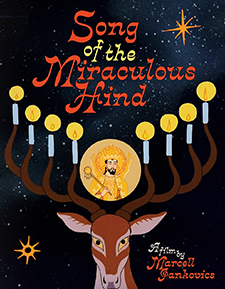
The Deaf Crocodile Deluxe Limited Edition 4K Ultra HD release of Song of the Miraculous Hind is a two-disc set that includes a Blu-ray with a 1080p copy of the film. It also includes a 60-page booklet featuring essays by Jennifer Lynde Barker and Walter Chaw. Everything comes housed in a rigid slipcase with a J-card slipcover, both of which feature artwork by Beth Morris It’s limited to 2,000 units, although Deaf Crocodile is releasing a standard version as well that omits the booklet and the slipcase. The following extras are included on both discs, all of them in HD:
- Commentary by Adam Rackoff, James Hancock, and Martin Kessler
- Mythic Origins, Sacred History, and the Making of National Identity in Song of the Miraculous Hind (16:49)
- Interview with Animators (49:34)
The commentary reteams James Hancock of the Wrong Reel podcast and animation producer Adam Rackoff, joined this time Czech-Canadian podcaster Martin Kessler. While Song of the Miraculous Hind was funded by the Hungarian government and produced as an educational tool for schoolchildren, they feel that it’s not just a history lesson and they hope to change opinions about it. Rather than worrying about all of that background, they say that it’s more rewarding if you engage it on its own terms (which is always good advice). One of the ways to do so is to examine it purely from a visual perspective, and they spend plenty of time doing just that, emphasizing its hand-drawn nature and also exploring the use of real historical artifacts. Yet they also discuss the making of the film, the stories that it tells, and the themes that it presents. It’s a great place to start if you want to delve further into the seemingly impenetrable mythology on display in Song of the Miraculous Hind.
Mythic Origins, Sacred History, and the Making of National Identity in Song of the Miraculous Hind is a visual essay by Evan Chester, who acknowledges that the film is Marcell Jankovics’ least accessible work due to the culturally specific stories that it tells, all of which feature different characters with nothing to tie them together. Chester provides an overview of Jankovics’ career, noting stylistic elements like transformations that would be reused in Song of the Miraculous Hind. He also explores the sources that Jankovics likely used in order to craft the four stories in the film, offering his own overview of the history and mythology involved. That includes breaking down some of the figures that are presented in the stories, which can prove helpful if you feel lost while watching the film.
Finally, there’s an online Interview with Animators that was conducted by Dennis Bartok of Deaf Crocodile Films, with Anna Klaniczay providing “live” translations. It’s actually just one of the original animators, Piroska Martsa, accompanied by composer Levente Szörényi. They describe their own backgrounds and explore their work with Jankovics, all while offering some insights into the changing sociopolitical framework of life in Hungary before and after Soviet control. They also discuss some of their favorite scenes and elements in Song of the Miraculous Hind.
To paraphrase Peter Shaffer, if one sees such sights in Song of the Miraculous Hind and what can one say, but Marcell Jankovics, then it’s equally true that one sees this kind of film on UHD in North America and what can one say, but Deaf Crocodile. They’ve been rescuing Eastern Bloc and post-Soviet animation from obscurity for Western audiences for many years now, and while Song of the Miraculous Hind may be particularly obscure in terms of the Hungarian stories that it tells, it’s still a stunning work of animation and a worthy addition to the Deaf Crocodile catalogue. Highly recommended for animation fans of all stripes.
- Stephen Bjork
(You can follow Stephen on social media at these links: Twitter, Facebook, BlueSky, and Letterboxd).